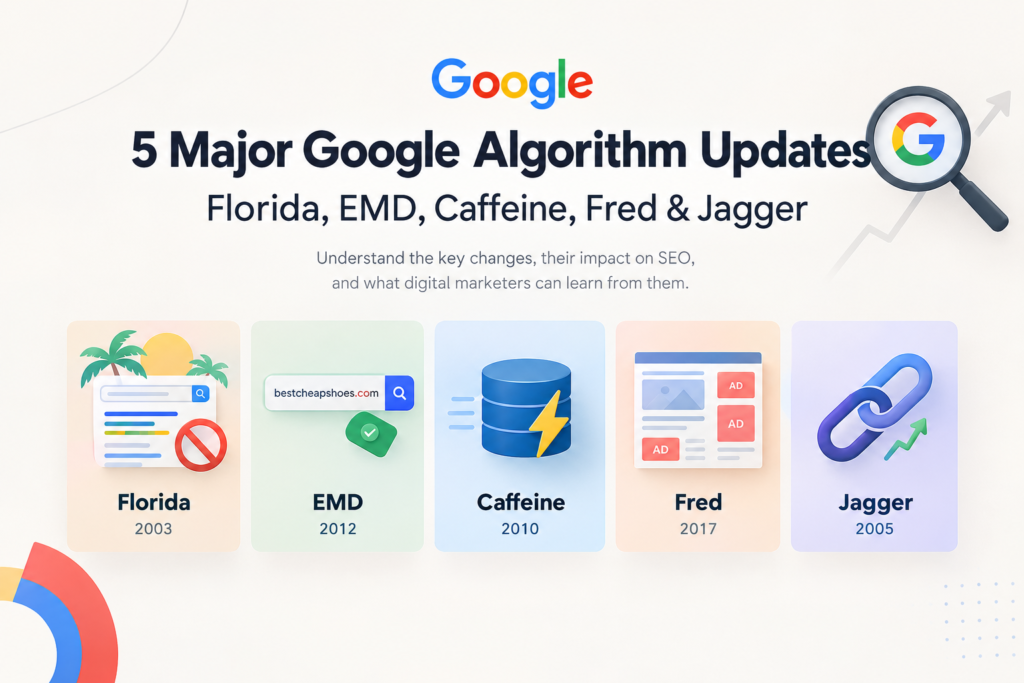
Explore the Five Major Google Algorithm updates that every marketer should know and learn how they changed SEO .
Table of Contents
- Introduction
- Google Florida Update
- Google EMD Update
- Google Caffeine Update
- Google Fred Update
- Google Jagger Update
- Key Elements of the 5 Updates
- Frequently Asked Questions
- Conclusion
Introduction
Google Search is constantly evolving. What worked for SEO a few years ago may not necessarily work today. From fighting manipulative link-building practices to improving the quality and usefulness of search results, Google has introduced numerous algorithm changes over the years.
For digital marketers, understanding these updates is important because algorithm changes can influence search rankings, organic traffic, content strategies, link-building practices, and overall SEO performance.
In this article, we explore five notable historical Google updates:
- Florida
- EMD
- Caffeine
- Fred
- Jagger
and what digital marketers can learn from them.
Google Florida Update
Released: November 2003
Focus: SEO manipulation and over-optimization
The Florida Update was one of Google’s most significant early algorithm changes. It was released in November 2003 and caused substantial changes in search rankings.
The update became particularly notable because it affected many commercial websites during an important shopping period.
What did the Florida Update target?
Florida is commonly associated with Google’s attempts to reduce the effectiveness of aggressive SEO techniques.
At the time, some websites relied heavily on practices such as:
- Excessive keyword optimization
- Manipulative link-building
- Repetitive keyword usage
- Search-engine-focused optimization techniques
The update demonstrated that strategies that worked previously could become ineffective after a change to Google’s ranking systems.
What can digital marketers learn from Florida?
The biggest lesson is that SEO should not depend entirely on manipulating ranking signals.
Instead, marketers should focus on:
- Relevant content
- Natural keyword usage
- Quality backlinks
- Good website structure
- User-focused experiences
Florida was an early indication that Google’s algorithms were becoming increasingly sophisticated.
Google EMD Update
Released: September 2012
Focus: Exact-match domains
The EMD (Exact Match Domain) Update was designed to reduce the ranking advantage that low-quality websites could receive simply because their domain name exactly matched a search query.
For example, imagine a website using a domain such as:
bestcheapshoes.com
If the site had very little useful content but benefited from its exact-match domain, it could potentially receive an advantage in search rankings.
Google’s EMD update targeted this type of situation.
What changed?
The update reduced the ability of low-quality exact-match domains to rank simply because their domain names closely matched keywords.
However, having a keyword in a domain name was not automatically a penalty. The primary issue was the combination of an exact-match domain and poor-quality content.
Why was EMD important?
The update reinforced an important SEO principle:
A keyword-rich domain name cannot replace a high-quality website.
For digital marketers, this means domain selection should be considered as part of branding and business strategy rather than relying on a domain name as an SEO shortcut.
Google Caffeine Update
Released: 2010
Focus: Speed, scalability, crawling and freshness
Unlike many Google updates that primarily targeted specific SEO practices, Caffeine was largely a major infrastructure change.
Google introduced Caffeine to improve the way its search engine could crawl, index, and process web content.
The web was growing rapidly, with more websites, social media content, news and frequently updated pages being published every day.
Google needed a search infrastructure capable of handling this growth.
What did Caffeine improve?
Caffeine improved Google’s ability to:
- Crawl more web pages
- Index content more quickly
- Process larger amounts of information
- Provide fresher search results
- Scale its search infrastructure
Google described Caffeine as a new web indexing system that allowed it to crawl and index significantly more content.
Why is Caffeine important for marketers?
Caffeine highlighted the growing importance of fresh and frequently updated web content.
It also demonstrated that SEO isn’t only about keywords and backlinks.
Technical factors such as:
- Website performance
- Crawlability
- Indexability
- Site architecture
- Content freshness
became increasingly important considerations for websites.
Google Fred Update
Released: March 2017
Focus: Low-quality, ad-heavy websites
Fred is the name the SEO community commonly gave to a Google ranking update observed around March 2017.
Unlike updates such as Panda or Penguin, Google did not officially confirm an update called “Fred.” The name came from the SEO community after significant ranking fluctuations were observed.
The update was widely associated with websites that appeared to prioritize revenue generation and advertising over user experience and content quality.
What types of websites were discussed?
SEO industry analysis commonly associated Fred with websites that had characteristics such as:
- Large amounts of advertising
- Thin or low-value content
- Aggressive monetization
- Poor user experience
- Content created primarily to generate advertising revenue
Google’s Gary Illyes later suggested that websites affected by the March 2017 changes should focus on following Google’s Webmaster Guidelines rather than trying to identify a specific “Fred” factor.
What can marketers learn from Fred?
The important lesson is that monetization should not come at the expense of user experience.
Advertising can be an important part of a digital business, but marketers should make sure that:
- Ads don’t overwhelm the content
- Pages provide genuine value
- Content addresses user intent
- Websites remain easy to navigate
Google Jagger Update
Released: 2005
Focus: Link quality and manipulative linking
The Jagger Update was introduced in multiple stages during 2005.
It became associated with Google’s efforts to identify and reduce the influence of low-quality and manipulative backlinks.
The update affected websites using various linking practices that were viewed as attempts to manipulate search rankings.
What practices were associated with Jagger?
The update was commonly linked with:
- Link farms
- Paid links
- Reciprocal linking schemes
- Low-quality backlinks
- Other manipulative link-building techniques
Google’s Matt Cutts discussed the Jagger rollout in several posts during 2005.
Why is Jagger important?
Jagger reinforced the importance of link quality over link quantity.
Instead of trying to obtain hundreds or thousands of backlinks, marketers should focus on earning links from relevant and trustworthy websites.
For modern SEO, this means link-building should be based on:
- Relevance
- Authority
- Editorial value
- Useful content
- Genuine relationships
Key Elements of the 5 Google Algorithm Updates
| Algorithm Update | Year | Main Focus | Key SEO Lesson |
|---|---|---|---|
| Florida | 2003 | Over-optimization & manipulation | Avoid aggressive SEO tactics |
| EMD | 2012 | Exact-match domains | A keyword-rich domain can’t replace quality |
| Caffeine | 2010 | Indexing & freshness | Technical SEO and fresh content matter |
| Fred | 2017 | Low-quality/ad-heavy websites | Prioritize users over excessive monetization |
| Jagger | 2005 | Link quality | Focus on relevant, natural backlinks |
Frequently Asked Questions
1. What was the Google Florida Update?
The Florida Update was a major Google algorithm change released in November 2003. It caused significant ranking changes and became associated with Google’s efforts to reduce the effectiveness of aggressive SEO and over-optimization techniques.
2. What was the purpose of the EMD Update?
The EMD Update was introduced in 2012 to reduce the ranking advantage of low-quality websites using exact-match domain names. The update demonstrated that simply having keywords in a domain name was not enough to create a high-quality search result.
3. What was the Caffeine Update?
Caffeine was a major Google indexing-system change introduced in 2010. It improved Google’s ability to crawl and index the rapidly growing web and deliver fresher content in search results.
4. Was Google Fred an official algorithm update?
Google did not officially name a ranking update “Fred.” The name was given by the SEO community to describe ranking changes observed around March 2017. Industry analysis associated the changes with low-quality, ad-heavy and aggressively monetized websites.
5. What did the Jagger Update target?
Jagger was a multi-stage Google update from 2005 that became associated with Google’s efforts to reduce the impact of manipulative and low-quality link-building practices.
Conclusion
Google’s algorithm history provides a useful roadmap for understanding how SEO has evolved.
The Florida Update demonstrated the risks of aggressive optimization. Jagger highlighted the importance of link quality. Caffeine showed how Google’s infrastructure evolved to handle an increasingly large and dynamic web. The EMD Update reduced the importance of exact-match domains for low-quality websites, while Fred highlighted the importance of providing genuine value instead of prioritizing advertising and monetization.
Although these updates occurred at different points in Google’s history, they share a common lesson:
Successful SEO is about building a useful website for people, not simply finding ways to manipulate search rankings.
For digital marketers, studying these historical updates can help explain why modern SEO places so much emphasis on quality content, technical performance, user experience, relevant links, and genuine value.